

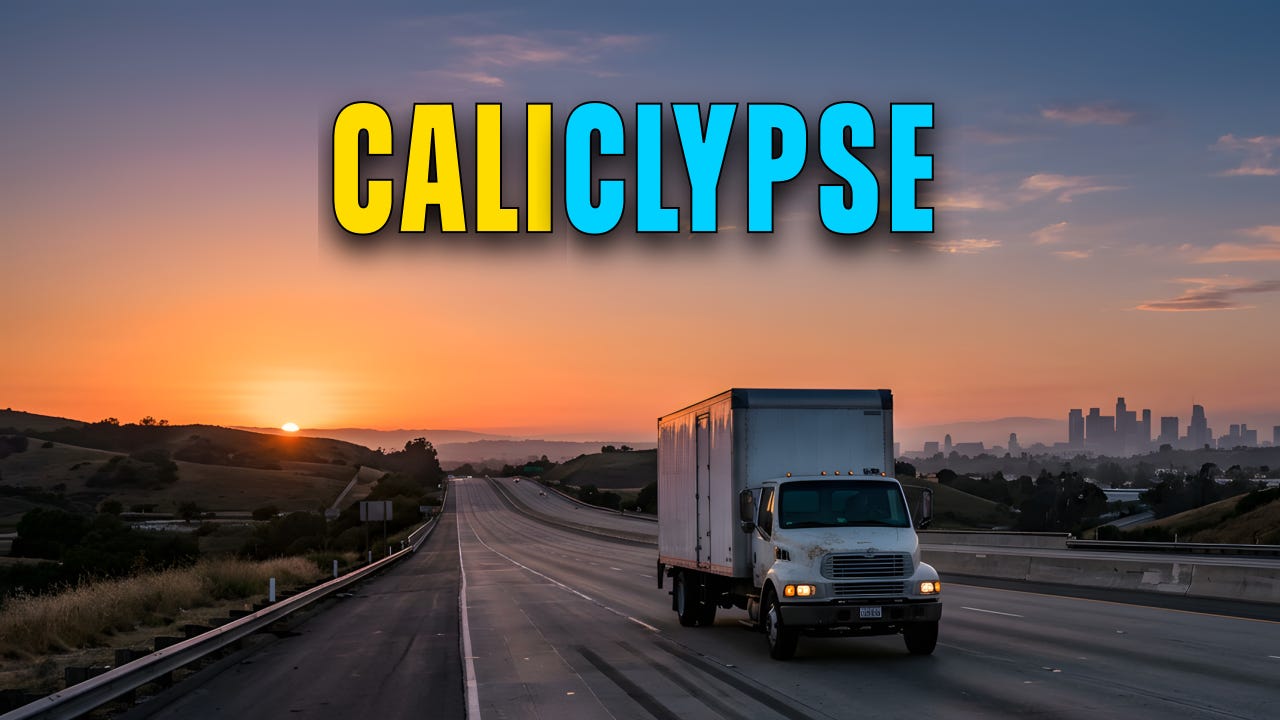
You didn’t vote in California. You didn’t run up its debts. You’ll be asked to pay them anyway.
A moving truck pulls out of a driveway in Los Angeles. The family inside earned well and paid a large share of the state’s taxes. They finally decided the bill wasn’t worth it. Multiply that truck by thousands. Every one that leaves shrinks the tax base. A smaller base means a bigger deficit. A bigger deficit means higher taxes on whoever stayed. Higher taxes load the next truck.
That loop has a name. Caliclypse is the fiscal death spiral where deficits force tax hikes, tax hikes drive out the people who pay them, and their exit widens the deficit that started it. California is the signature case — pension promises that outrun revenue, chronic deficits, and an accelerating exodus of the taxpayers who fund the whole system. It is not the only case. Any state or city can enter the same spiral.
THE SPIRAL
Spending and pension obligations outrun revenue. The deficit becomes structural, not occasional.
The state raises taxes and fees to close the gap.
High earners and mobile businesses — the people who can leave — leave.
The tax base shrinks. The deficit widens.
Return to step 2, with less room each time.
Each turn tightens. The people with the most options exit first, so every lap leaves a poorer, more captive population behind to carry a heavier load.
WHERE YOU SEE IT
You are watching a Caliclypse event in any state when:
A headline reports another business or billionaire moving out of state, and the coverage treats it as a lifestyle story instead of a fiscal one.
A state proposes a new wealth tax, exit tax, or fee to plug a deficit that keeps reappearing.
Pension funds report they are underfunded, and the fix on offer is a bigger contribution rather than a smaller promise.
A governor calls a shortfall temporary while the trajectory says otherwise.
Someone floats a federal rescue for a state that overspent — framed as saving workers, not the officials who made the promises.
Any one of these is a symptom. Together they are the diagnosis.
HISTORY
Detroit, 2013. Once America’s fourth-largest city, it filed the largest municipal bankruptcy in U.S. history. Essential services kept running. Scale delayed the reckoning; it did not prevent it.
New York City, 1975. A fiscal crisis ended in state-supervised restructuring, not a federal check. The discipline of non-rescue was the condition for recovery.
Puerto Rico, 2016– . Washington intervened. The intervention protected creditors and process, not the ordinary residents left with cut services and higher costs.
OBJECTIONS
“California has the world’s fifth-largest economy — it’s too productive to fail.” Detroit was America’s fourth-largest city. Scale buys time, not immunity. The larger the entity, the larger the eventual adjustment — and the more Serfs who absorb it.
“The federal government will never let California default.” That expectation is the disease, not the cure. A guaranteed rescue removes the pressure Californians need to force reform. The honest move is for Washington to rule a bailout out, loudly and in advance.
“A default would wipe out ordinary pensioners.” Restructuring can protect small pensions while renegotiating the large claims and bond debt that no other process can touch. Bankruptcy is not the catastrophe — it may be the only legal path to relief.
THE FIX
The answer is not to save California from itself. It is to make sure Serfs in every other state are not forced to pay for choices they never voted on.
That is Too Big to Bailout: remove the bailout presumption, so the people who make the decisions know they won’t be rescued — and the cost of failure lands on those who chose it, not on everyone who didn’t.
→ Read the solution: Too Big to Bailout
SUMMARY
A moving truck is not a lifestyle choice. It is one frame of a spiral — deficits, taxes, exodus, wider deficits — turning toward a default that California’s own leaders keep insisting can’t happen. When it does, the fight will be over who pays: the state that spent the money, or the country that didn’t. Name the spiral, and you can see the whole thing coming. Refuse the bailout, and you decide the answer in advance.