

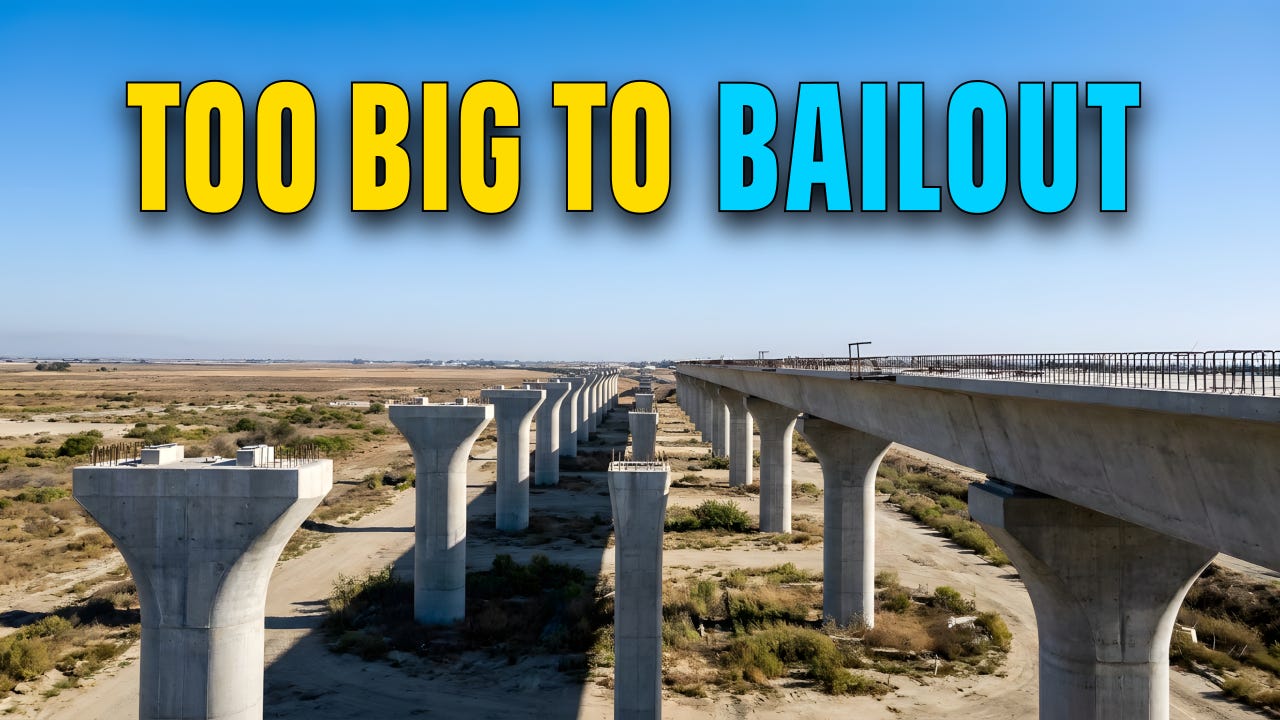
The voters in every state should know: You vote for it. You pay for it.
When a state pension system goes unfunded for twenty years, it isn’t an accident — it’s a bet. The politicians who voted for the promises knew the bill would eventually land somewhere else: a future generation, another state’s taxpayers, a federal bailout.
Fiscal recklessness becomes rational the moment the worst-case scenario is a public rescue. The bailout presumption runs from the largest banks in New York to the smallest city in every State. Too Big to Bailout removes the reliance on rescue.
SOLUTION
The fix is a hard pre-commitment: no public rescue for any entity — government or private — when their own choices lead to failure.
At the federal level, Congress is barred from transferring resources, guaranteeing debt, or backstopping lending for states or municipalities in fiscal distress.
At the state level, mirror legislation closes the next link: no state rescue for cities, counties, or pension systems.
Any exception requires a supermajority — making rescue structurally costly rather than the path of least resistance.
Failed entities face restructuring: writedowns, clawbacks for those who profited on the path to failure, and reduced pension claims where necessary.
Restructuring explicitly protects small pension recipients — the workers who paid in and relied on the promise — while subjecting large claims to negotiation.
HISTORY
Detroit’s 2013 bankruptcy — the largest municipal bankruptcy in U.S. history — completed without federal rescue. Essential services continued. New York City’s 1975 fiscal crisis ended in state-supervised restructuring, not a federal check; the discipline created by non-rescue was the condition for recovery. Rhode Island reformed its pension system in 2011 under political pressure with no external transfer. The EU’s Maastricht Treaty encoded the no-bailout principle as a constitutional pre-commitment — and when Europe abandoned it for Greece in 2010, the result was years of extended moral hazard, not resolution.
OBJECTIONS
“Refusing to bail out a failing state harms innocent people who had nothing to do with the fiscal decisions.” Bailout transfers the harm to people in other states who also had nothing to do with those decisions. Structured restructuring — with explicit protections for small beneficiaries — is more equitable than cross-jurisdiction cost transfer. Detroit demonstrated it’s survivable: essential services continued while excessive claims were reduced.
“Letting a major state fail would trigger financial contagion across the whole economy.” This is the same argument made for every too-big-to-fail rescue, and it always produces the same result: the rescue guarantee ensures more recklessness, which produces a larger crisis later. The answer is a well-designed bankruptcy pathway that contains contagion — not an open-ended backstop that makes the next failure inevitable.
“Pension obligations to public workers can’t be restructured without breaking promises to the people who earned them.” They can — and the distinction that matters is between the modest pensions workers relied on and the large claims powerful actors negotiated for themselves. Detroit protected smaller beneficiaries while reducing excessive claims. Those are not the same promise, and they shouldn’t receive the same protection.
SUMMARY
Bailouts don’t rescue people from bad luck. They rescues decision-makers from the consequences of bad decisions — and move the cost to everyone who had no say. Remove the bailout presumption, and fiscal responsibility becomes rational again. Every unfunded promise, every structural deficit, every bet placed with someone else’s money gets repriced the moment the backstop disappears. Detroit showed the restructuring is survivable. The question is whose money covers the failure: the people who chose it, or everyone who had no say.