

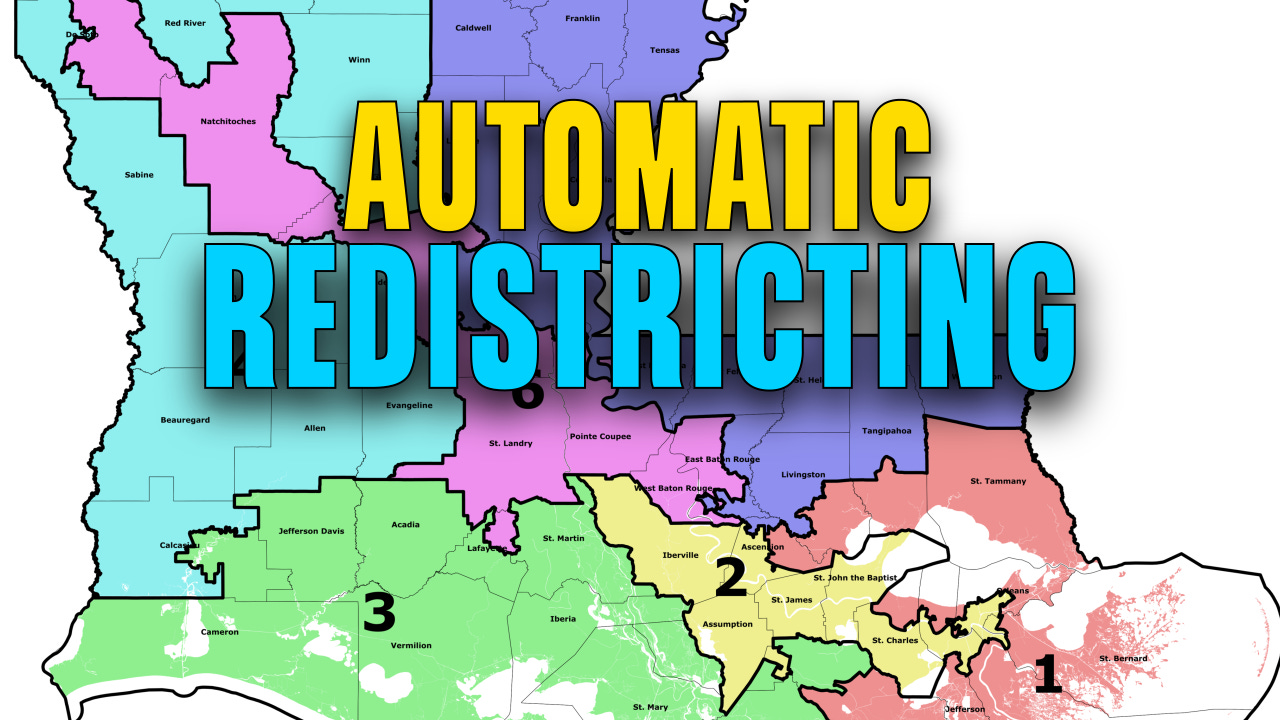
In a fair election, voters choose their representatives. In a rigged one, representatives choose their voters. The map is the rig.
After every census in most states the politicians who are currently in office sit down to redraw voting districts. Parties draw boundaries, then run inside them. We would not let a runner paint his own finish line — but in American elections, we let the runners draw the entire track.
The party in power tilts the map toward itself. The party out of power usually negotiates some safe seats for themselves in exchange for being quiet. The people not at the table are voters.
That is Engineered Elections — the structural manipulation of districting, ballot rules, and candidate access to secure outcomes regardless of how people actually vote. Gerrymandering is its purest form, because it works before a single ballot is cast: the winner is chosen when the lines are drawn.
The solution is Automatic Redistricting. Take the pen out of human hands and create district maps with a simple public formula that uses only population and geography. A formula that never sees party or racial data can never draw a partisan or racial map.
Iowa hands its maps to nonpartisan staff who are forbidden from looking at party registration or incumbent addresses — and routinely produces some of the most competitive congressional districts in the country.
Political scientists have shown that maps a computer draws for compactness alone yield far more competitive seats than the maps legislatures actually produce — proof the distortion is a choice, not geography.
The federal courts have stepped back from the problem entirely: they will not police partisan gerrymandering, and recent rulings have narrowed what else a state may consider — leaving the incumbent-protection motive standing untouched.[1]
Those aren’t accidents of geography. They’re the predictable output of letting the people who win elections draw the lines that decide them.
THE SOLUTION
The Automatic Redistricting Standard — five rules that take the pen out of human hands.
A simple formula draws every congressional district. Not a legislature, not a commission, not a court — a formula.
It considers only four objectives: equal population, geographic compactness, contiguity, and preservation of existing political subdivisions like counties and cities where compactness allows.
No partisan registration, no voting history, no incumbent addresses, and no race data may ever enter it.
The output is legally binding. No legislature, commission, court, or governor may alter a single line.
The formula is public and and results are independently audited.
WHY THE AUTOMATIC REDISTRICTING STANDARD WORKS
Today the public fight is about who holds the pen: which party controls the legislature, who gets the seats on the commission, which judge hears the challenge. Automatic Redistricting makes the pen irrelevant. The only question left is whether a map matches what the formula produces from population and geography — and that is a question a captured incumbent cannot lobby, litigate, or trade away.
That is what dismantles the safe seat. A safe seat is how incumbents are protected from voters; it is Deceptive Democracy in physical form — a real election whose outcome was settled when the lines were drawn. Remove the drawn perimeter and every incumbent has to win the median voter all over again. The map stops being a shield.
The effect reaches past any single map. Once you can point to a formula that draws fair lines in seconds, every hand-drawn map looks like what it is — a designed choice that someone benefits from. Independent commissions, which once sounded radical, start to look like a halfway measure. And the question no one in power wants asked finally gets asked out loud: why do the people whose careers depend on the result get to draw the boundaries at all? The standard asks readers to stop arguing over who should control the map and start asking why anyone on the ballot controls it.
THE OBJECTIONS
“Hasn’t the Supreme Court already dealt with gerrymandering?” Not in any way that helps — and the latest ruling makes the case for a formula stronger, not weaker. The Court won’t touch partisan gerrymandering at all, and in 2026 it nearly closed the door on race as a districting consideration too, while leaving incumbent protection explicitly permissible.[1] A formula that never sees race or party steps cleanly around both rulings: it cannot be challenged as a racial gerrymander, and it cannot be drawn as a partisan one.
“A race-blind formula will dismantle majority-minority districts and erase hard-won minority representation.” For decades this was the strongest objection to blind maps — and events have overtaken it. Deliberately drawn majority-minority districts are now themselves constitutionally suspect.[1] A formula that never sees race is the most durable map a state can adopt, because race never entered it. It produces whatever representation compact geography produces, decided by where people actually live rather than by who is sorting them.
“Any formula embeds political assumptions — neutrality is a myth.” True, and that is the point. How you measure compactness and weight county lines are real choices. But when the code is public and audited on a fixed schedule, every assumption is visible and only contestable on technical grounds, in the open. Compare that to a closed-door session whose load-bearing assumption is the incumbents’ job security.
“Taking the decision away from elected representatives is undemocratic.” Letting politicians choose their own voters is what’s undemocratic. The democratic act is the vote, and the formula never touches the vote — it only stops the people on the ballot from drawing the lines around it. Removing a conflict of interest isn’t a loss of democracy. It’s the precondition for one.
Automatic Redistricting asks the ultimate question: Why should people who win elections be allowed to draw lines that guarantee reelections?
In April 2026, the Supreme Court struck down a Louisiana congressional map in Louisiana v. Callais, ruling 6-3 that the state’s second majority-Black district was an unconstitutional racial gerrymander; in dissent, Justice Kagan called the Voting Rights Act’s Section 2 “all but a dead letter.” Justice Alito’s majority opinion was explicit that states remain free to draw maps that “protect incumbents” or favor a party — only race is now nearly forbidden as a motive.